Tuesday, July 21, 2015

EARLY READING SKILLS to work on

Whether you are teaching one child to read or working with a whole class of students, it's handy to have a checklist to assess the skills they have mastered and what they have yet to work on.

Reading is a very complex skill, involving not just the recognition of symbols (letters), but the range of sounds and combinations of the letters, the arrangement of the letters into syllables and meaningful words, the formation of phrases and sentences, the recognition and use of punctuation, and the ability to read with understanding of the context and meaning.

Here is a checklist you can download to use for assessing pre-reading and early reading skills:

                                                        "Early Reading Skills" Checklist

There are some blank lines for you to add any extra aspects that you wish to assess.

Most of the terminology should be self-explanatory, but here is an explanation of some of the terms used in the list:

'Voiced' letters use the voice box: e.g. b, d, g, v, z;
'non-voiced' letters don't use the voice box: e.g. p, t, k, f, s

Directional confusion - e.g. reading from left to right, missing parts of text

Digraphs -  2 letters forming one sound – they can be consonants or vowels; e.g. vowel digraphs ay, ai, ee, ea; consonant digraphs sh, th, ch, ck, ng

"1st, medial, last sound in cvc word": a 'cvc' word is one formed from a consonant, a vowel and a consonant, e.g. c-a-t, d-o-g. Children need to be able to identify the sounds they hear in the word - the 1st sound, medial (middle) sound and last sound.

'short vowels' are: a as in at, e as in egg, i as in it, o as in off, u as in up

"talking" segments in text refers to speech segments, usually indicated by quotation or "talking" marks

Alliterating is forming phrases or sentences where most or all of the words begin with the same sound, e.g. "four fun frogs", messy Millie", "six silly snails sailed on six slippery sausages"

"Hearing incorrect/odd structure in sentence"- children need to be able to hear if they have made a mistake resulting in an incorrect sentence, e.g. if they read "the cat sat in mat", they should realise it's incorrect and go back to re-read the sentence

Varying volume and pitch - refers to using expression when talking and reading aloud, making the voice softer or louder, making it go up and down rather than just a monotone.

Non-word - refers to a 'word' that is not an actual real word, e.g. 'nonsense' words like fip, rog, lin, semp; these can be very useful (and fun) in helping children to decode words.

"own vocab" refers to a basic collection of words that  child can read, and will vary with each child: usually the child's name, possibly other family names, plus simple, familiar words such as zoo, cat, a, the, I, Mum, Dad...

"weird words" refers to words that don't follow normal spelling rules or patterns; children need to be able to remember these by sight. Examples are: the, they, you, come, some, one, two

Wednesday, July 15, 2015

Learning letters and words: "Smack" game


"SMACK!" is a fun game for children of any age, but it's especially useful for Grade 1-2 children as it practises spelling short words and also letter formation.

Each player needs pencil and paper, and you also need a blackboard or whiteboard.

The game needs at least 3 players. One player is the "Letter Writer"; the others write a 5-letter word (or a 4-letter word if the players are younger) on their paper.

The Letter Writer begins writing letters of the alphabet on the board. The others cross off any letter that appears in their word.


When a player has crossed off all his letters, he hits the table and calls out "Smack!" This player now has a turn to be the Letter Writer.

Note- if a player's word has a repeated letter, he can only cross off one at a time... so he may need to wait quite a while before the Letter Writer repeats that letter!

You can vary the number of letters in the words for each round if you like - especially for older players. You could also let each child in turn be the Letter Writer if you prefer.


Friday, July 3, 2015

Learning Letter Patterns: /oo/ as in foot, fool

This is a game I made a few years ago to help my Reading Intervention students.

The /oo/ pattern in words can be confusing for beginner readers.

The long oo sound as in boot is learnt relatively easily, as zoo and too are words that children learn early on.

Then they come across words such as look and good or pool and tool, in which /oo/ can have different sounds.

The pronunciation can depend on your accent, of course, e.g. 'look' or 'good' with a Scottish accent can have a long oo sound (- it can be fun and quite enlightening to play around with different accents when teaching children to read!)

You can download the game board and word cards to print onto light card, then laminate for best results before cutting out the cards. You will also need a die (dice) and some tokens or 'movers' (e.g. counters, buttons).


Look Look game board


Look Look game - word cards


This game will be available for free download during July 2015; you are welcome to use it for personal, non-commercial educational purposes.

Thursday, June 25, 2015

Encouraging Struggling Learners


Because learning to read is seen as such a fundamental and vital skill, children who don't manage it easily can become very discouraged and can lose faith in themselves.

No matter how we try to discourage comparison and competition, children who are falling behind with reading are usually very aware of their 'failing'.

It's really important to highlight the other areas in which they are strong. Whether they have skills at sports, in art or music, in construction and invention, have wide general knowledge, or are 'just' caring and kind people, we should be encouraging their self-esteem by focusing on these positive attributes rather than just the areas in which they struggle.


It's also important for children to see that other people are not perfect, that others have areas in which success is more difficult, and that it's normal. It's very easy for a child whose school work is blighted by reading difficulty to feel that they are 'dumb' and that everyone else is OK.

Adults can help by focusing on and encouraging the effort that everyone makes in whatever area is a challenge, rather than just on achievements. They can also show that adults are not perfect and that they are always learning and making mistakes - and that it's OK. Teachers, parents and other 'mentors' can have a very positive effect by showing that they are relaxed about making mistakes (and even letting children correct them)!


You are welcome to print off the posters here to encourage your learners; there are 'colour-in' versions below if you have children who like colouring. Click on the poster to open the .PDF to print.


Thursday, June 18, 2015

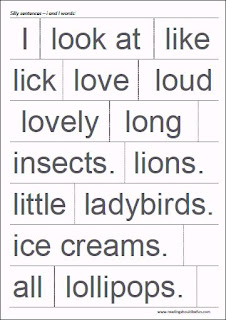
Silly Sentences - l and l words

Not surprisingly, many children get confused with capital i and lower-case l (in many fonts they are identical, and beginner readers are not always able to use the context to identify the letters - some will even read "I" in the middle of a word instead of l).

I created some words using I, i and l to help children practise these letters, and they had lots of fun making "silly sentences" with the words.

You can download the sheet of words, print onto light card and laminate before cutting up for best results, or you can just write these or similar words onto pieces of card.

Add extra words if you like, but remember to allow for correct punctuation - words with capital letter for the start of the sentence and full stop/exclamation mark etc. for the end of the sentence.

Here is the i/l Silly Sentence sheet:


You are welcome to download this sheet and use it for educational, non-commercial purposes, or to link to this page, but not to share the file itself.

Wednesday, June 10, 2015

Silly Sentences - for sight words practice, grammar and sentence structure

"Silly Sentences" are lots of fun for children who are beginning to read words. You can make your own word cards from cut up cereal boxes etc. and include words that your child can read easily, including family names, with a few extra words to help make a sentence.

Your child can help to decide which words are needed to make a short sentence. Don't forget a card with a full stop (or exclamation mark, or, if necessary, a question mark) to put at the end. You can also discuss the need for a capital letter at the start of the sentence. This is an excellent way to introduce your child to basic essential punctuation, and a fun way to practice grammar and sight vocabulary.


Encourage your child to swap the word cards around to make different sentences, and to check if they 'sound right' (encouraging awareness of sentence structure) and if they make sense. Add in extra cards as needed and put in some 'silly' words to make it more fun.

This game can be played over and over, adding in more cards as you like, and extending your child's sight vocabulary as you go!

You can keep the cards in a little zip-lock bag, and you can write the words in different colours if you wish. You may want to write verbs and adjectives in a different colour, to help your child to develop awareness of the function of different kinds of words.

Here is a sheet of words you can print off onto light card to start off with:


Click on the picture to open a .pdf document which you can print. This printable is free for educational/private use. You are welcome to pin this but not to distribute the file directly ;)

Friday, June 5, 2015

Word Wizard Challenge sight word game

This is the printable reading game for this month - it's a scan of a board game I made a few years ago.

I originally drew it it black, printed it on coloured card, then decorated with glitter pen, glitter and stars before laminating; simple but it's been very well-used and it's been helpful to get children to practise common sight words.

I added in several words (e.g. Mum, Dad, cat, zoo) which are not on many Sight Words list, but give beginner readers confidence as they often seem to pick them up easily.

It's fun and rewarding to make your own board games to help your children learn, and children often have their own ideas to contribute, too!

Here is the Word Wizard Challenge game:

 
Word Wizard Challenge game
Word Wizard Challenge instructions.

Click on the links above to open a .pdf file to print (the instructions are on a separate page - you can print them on the back of the game if you like). You are welcome to download and print this game for your personal, educational use. It will be available through June.